
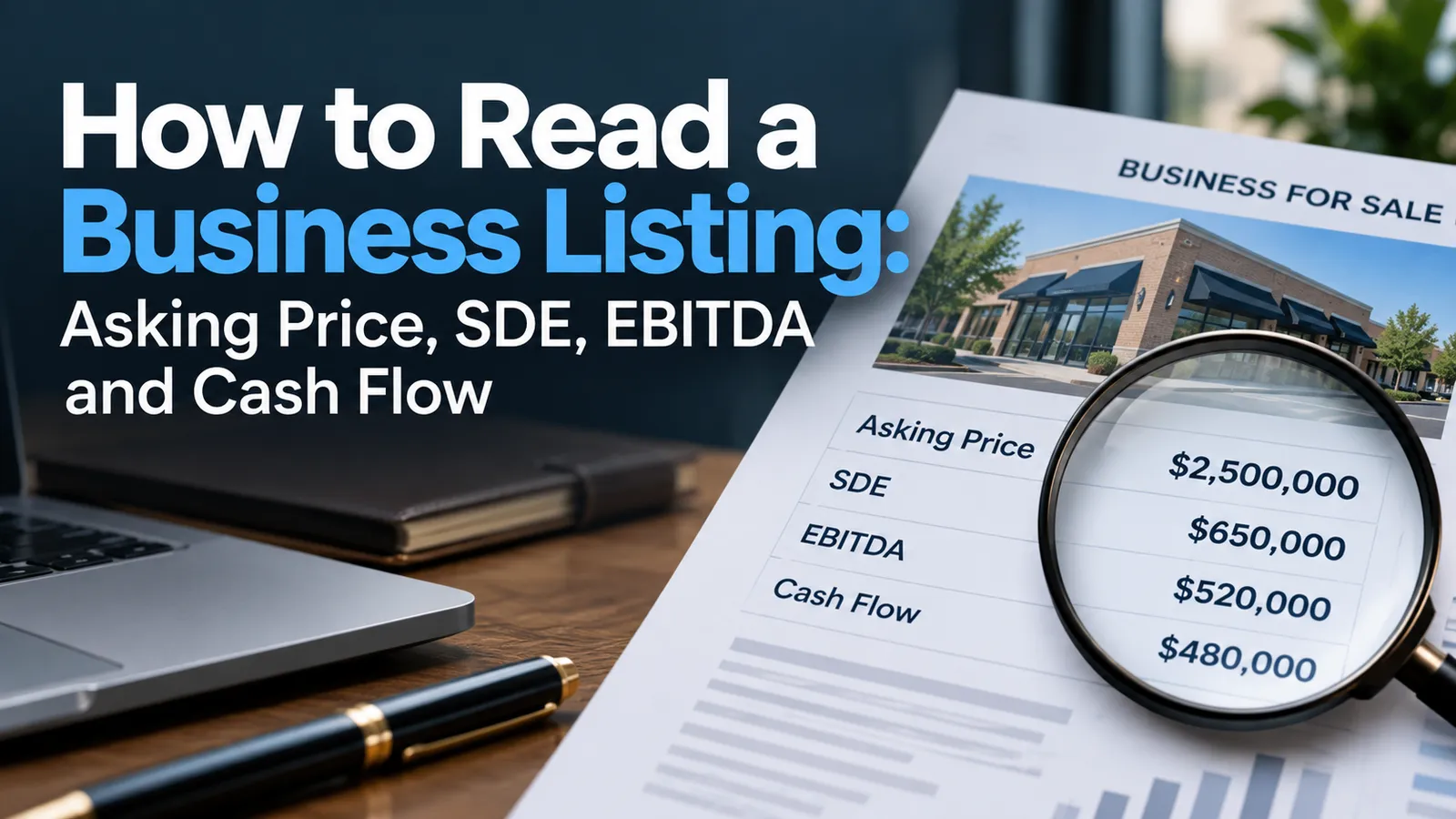
A business listing is a sales document, not a set of financial statements.
It is written to get you interested, and it does that job well. Your job is to know what each number means and which numbers are missing.
Here is how I read one.
1. The asking price
In short, the asking price is what the seller and broker hope to get. It is not what the business is worth, and it is not what it will sell for.
On the deals brokers reported to BizBuySell for 2025, the average sale price came in below the final asking price in almost every sector:[3]
Restaurants: 0.88 of the asking price
HVAC: 0.93
Gas stations: 0.95
Websites and ecommerce: 0.99
Those are mostly deals under $1m, and a ratio to the final asking price hides any cuts made earlier. Treat them as a sense of direction, not a discount to apply.
Worth noting, many listings show no price at all. As of October 24, 2026, 1,133 of the 4,414 active listings on NextCompany did not state an asking price.
That is normal for larger businesses, where the broker wants buyers to make the case for value rather than anchor on a number. It means the earnings figures carry the whole listing.
It is also very important to know that during an actual sale, there is a big difference between cash, earn outs and the seller potentially holding some of the debt
2. The earnings figures
Most listings show revenue and one earnings number. That number goes by 3 names, and they are not the same thing.
SDE: Seller's discretionary earnings. Pre-tax profit with the owner's salary, perks, interest, depreciation and one-time costs added back. BizBuySell describes it as the full financial benefit a business generates for its owner.[1]
Cash flow: On most small business listings, this is SDE under another name. BizBuySell calls SDE the preferred measure of cash flow for owner-operated businesses.[1]
EBITDA: Earnings before interest, taxes, depreciation and amortization.[2] On a listing it usually means the owner is treated as an employee, with a market salary for their role already subtracted.
The difference is the owner's job.
SDE assumes you will do that job yourself. EBITDA assumes someone you pay will do it. BizBuySell notes that businesses earning over $1m to $2m are usually valued on EBITDA, because their buyers plan to hire managers.[1]
Here is why it matters.
Assumptions:
Asking price: $2,000,000
SDE: $500,000
General manager to replace the owner: $150,000 with payroll taxes and benefits
Quick Math:
Multiple of SDE: 4.0x
EBITDA after the manager: $350,000
Multiple of EBITDA: 5.7x
Same business, same price. If you plan to hire the manager, you are paying 5.7x, not 4.0x.
As of October 24, 2026, 2,661 active listings on NextCompany stated SDE or cash flow, 930 stated EBITDA and 969 stated neither. Where an asking price was shown, the median was 4.2x SDE and 5.0x EBITDA. The EBITDA listings tend to be larger companies, so those two medians describe different groups of businesses.
I believe the first question on any listing is simple. Whose salary is inside that earnings number.
3. What the listing leaves out
A listing gives you the headline. The deal lives in the details it does not show.
Working capital: Most deals are priced cash-free and debt-free. The seller keeps the cash and pays off the debt, and the buyer expects a normal level of receivables and inventory at closing. If working capital comes in below the agreed target, the price goes down.[4]
Inventory: It may be included in the price or added at cost. Only 909 of the active listings on NextCompany stated an inventory value as of October 24, 2026.
Real estate: It may be owned, leased or sold separately. Roughly half of those listings, 2,148, said which. A short lease can matter more than the price.
The add-backs: The listing shows the total, not the list. A one-time lawsuit is a fair add-back. A recurring marketing budget is not.
The trend: One year of earnings tells you very little. Ask for 3 years and the trailing 12 months.
Concentration and dependence: How much revenue comes from the top customer, and how many of the relationships run through the owner.
Location: 1,167 active listings named no state. That is a confidentiality choice, not a red flag.
Lenders will check these figures even if you do not. Under the SBA's updated rules for change-of-ownership loans, effective October 1, 2026, lenders must reconcile the seller's financial statements and tax returns with IRS transcripts, normalize earnings, analyze the add-backs and prove the cash.[5] If adjusted earnings do not support the price, the loan gets smaller or the buyer puts in more equity.[5]
This means the earnings on a listing are a claim until the tax returns agree with it.
4. Verify everything
The listing is a sales document. You are going to need to verify every number that is here. For the most part, this document should be used as a basic starting point.
Many business listings contain information that is anywhere from slightly off to completely wrong.
It is good to understand what industry standards are for various companies.
For example if a plumbing company is claiming 80% EBIDTA margins that should be a red flag. Plumbing companies typically have margins between 15-25%.
Conclusion
A listing tells you whether a business is worth a closer look. It does not tell you what to pay.
Read the asking price as a starting point, find out whose salary sits inside the earnings, and write down every question the listing leaves open before your first call with the broker.
The price you should pay starts with earnings you have verified, after paying someone to do every job the owner does today.
Cheers
Josh Bobrowsky
Asking prices are not sale prices, and nothing here is financial or legal advice.
Sources
BizBuySell. (2026). Seller's Discretionary Earnings (SDE): An Overview. BizBuySell. BizBuySell's overview of seller's discretionary earnings
U.S. Securities and Exchange Commission. (2022). Non-GAAP Financial Measures, Question 103.01. Division of Corporation Finance. SEC guidance defining EBITDA
BizBuySell. (2026). BizBuySell Insight Report data tables, 2025 transactions by sector. BizBuySell. BizBuySell Insight Report data tables
Statz, A. (2026). What "Cash-Free, Debt-Free" Really Means When You Sell Your Business. Exit Strategies Group. Exit Strategies Group on cash-free, debt-free deals
Womble Bond Dickinson. (2026). SOP 50 10 8.1 Reshapes Change-of-Ownership Lending. Womble Bond Dickinson. Womble Bond Dickinson on SOP 50 10 8.1